Publications
AURP Benchmarking Survey 2023: Advancing Communities of Innovation 
AURP's Benchmarking Survey 2023: Advancing Communities of Innovation, in collaboration with Stiletto Consulting Ltd., unveils insights from North American research parks and innovation districts, offering a glimpse into their evolution and future trajectories.
Article Download
Read the Press Release
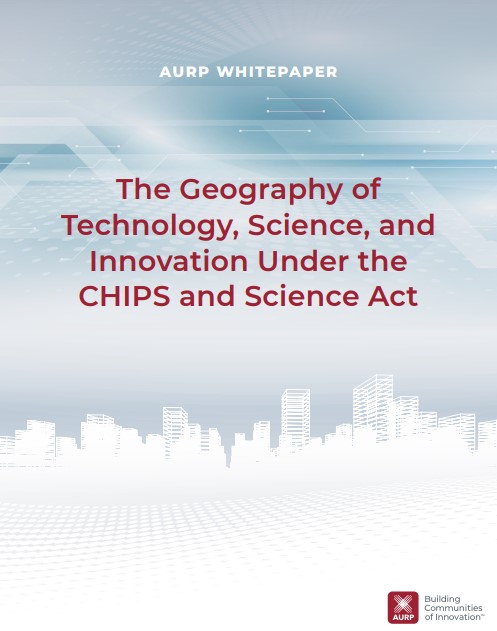
With a robust array of new federal policies supporting innovation and tech-based economic development, expanding the impact and reach of university-based research parks and innovation districts across the U.S. is vital in fueling the nation’s economic growth and global competitiveness, according to this new white paper from AURP. This report showcases a dynamic range of ways organizations – such as research parks, innovation districts, businesses, universities, federal labs, states, regions and local communities – engaged in science and tech-based economic development can leverage the unprecedented amount of federal grant funding authorized in the CHIPS and Science Act.
Research parks, innovation districts and related entities across the United States should prepare and strategize now to compete for federal funding from the recently enacted CHIPS and Science Act of 2022, according to a new white paper from AURP. Prepared by Brian Darmody, AURP Chief Strategy Officer, this timely white paper showcases a dynamic range of ways organizations and institutions – such as research parks, innovation districts, businesses, universities, federal labs, states, regions and local communities – can leverage the unprecedented amount of federal grant funding authorized in the CHIPS and Science Act.
AURP and BHI Announce Article in Journal of Commercial Biotechnology
Creating Communities of Life Science Innovation in the U.S.: History of Critical Factors That Helped the BioHealth Capital Region Emerge (Vol 26, No. 1, March 2021)
In this joint article prepared by AURP CEO Brian Darmody, and BioHealth Innovation (BHI) CEO/President Richard Bendis, these leaders outline the history of critical policy factors leading to the growth of the bio-economy in the U.S. plus specific leadership and other factors in the Capital Region of Washington, DC, Maryland, and Virginia including policies and trends such as the Land Grant Act, Bayh-Dole Act, NIH's founding, growth of the venture financing industry, and the emergence of research parks and innovation districts.
Article Download
Communities of Innovation - A State of the Practice, Benchmarking Report
This study, A State of the Practice of University Research Parks, is intended to provide a current look at parks today, acting as an extension to similar surveys conducted in 2002, 2005, 2007 and 2012. This is intended as a snapshot of where we stand as a community. Its purpose is to allow us to see how we've changed as we embark on the future.
Download the Communities of Innovation - Benchmarking Report
Driving Regional Innovation and Growth
As national and regional economies recover from the most severe global recession since the Great Depression of the 1930’s, there is a growing emphasis on the importance of innovation for sustained economic growth and competitiveness in today’s global, fast-paced, knowledge-based economy. Not only is innovation critical for industry development, it directly impacts the standard of living found in a nation and its regions. University research parks are a successful way to advance innovation and create economic growth in regions across North America, according to a new report, “Driving Regional Innovation and Growth,” prepared by Battelle’s Technology Partnership Practice (TPP) in partnership with AURP. Further, university research parks are an effective way to create new employment opportunities for existing technology companies, according to the report.
Download the Driving Regional Innovation and Growth
The Power of Place 2.0: The Power of Innovation
The Association of University Research Parks (AURP) released The Power of Place 2.0: The Power of Innovation in 2010. The Power of Innovation, an update to The Power of Place: A National Strategy for Building America’s Communities of Innovation, outlines the role the federal government can take to use research parks and other innovation assets to create jobs and remain a front runner in the global technology competition.
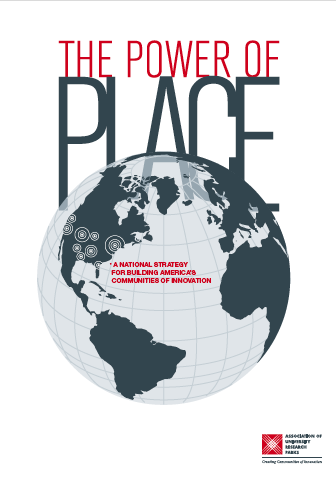 The Power of Place The Power of Place
The Power of Place: A National Strategy for Building America's Communities of Innovation calls for specific legislative and policy reforms to encourage:
- Development into designated Communities of Innovation
- Inflow of financial and facility capital into these zones
- Cluster creation development
- Support for private companies and academic research within these Innovation Zones
Download The Power of Place.
 Understanding Research, Science and Technology Parks: Global Best Practices Understanding Research, Science and Technology Parks: Global Best Practices
The National Research Council report details findings from a symposium held in 2008 spotlighting parks' contributions to government missions and commercializing university research. It highlights the broad range of S&T parks, including both university- and laboratory-based parks as well as large- scale industrial models.
|